
COMMEMORATING YOM HASHOAH , THE HOLOCAUST MEMORIAL DAY 2026, AND THE 10TH ANNIVERSARY OF THE PASSING OF ELIE WIESEL
GREETINGS TO THE ORGANISERS OF THE SHTETL SONGS EXHIBITION at the ZARASAI COUNTY MUSEUM
March 31st, 2026
Dear Friends, the organisers of the Shtetl Songs exhibition, the Zarasai County Museum, the guests, and visitors,
With pleasure, we have learned about organising the Shtetl Songs exhibition of our art collection at your museum. We are grateful for your interest and attention.
Your Museum is situated in a special and very attractive place, both historical and beautiful, and we are very glad to hear that such an inviting and attractive city also has such a good museum, keeping up the best cultural traditions.
The fact that our exhibition takes place in the native city of Yehuda Pen is very meaningful and warming up for us. It really shows the continuation of the special spirit which is maintained via art and which is essentially meaningful for humanity.
We also remember that the shtetl which once was thriving in Zarasai, had its tragic end on August 26, 1941. To have the artworks commemorating the life of the shtetls at the place where such an ultimate tragedy occurred, as in many other places in Lithuania, which we know and were visited during the years, brings yet another, deeply special meaning to us by having this exhibition at your museum.
The timing of the exhibition from this point of view just cannot be better. On April 13-14th, 2026, a special day in memory of the Holocaust , Yom HaShoah, is commemorated in Israel and in many countries world-wide. Our exhibition in your museum commemorates the day in a special way, reminding people about the life destroyed, and people annihilated. But their souls are still reminding us about them – from the artworks, if and when we would be thoughtful about them and attentive to their memory. Remembrance is an essential purpose of art, in our understanding.
From this point of view, our exhibition, with Michael’s work dedicated to our dear friend Elie Wiesel, is also a tribute to him. Later this year, on July 2nd, 2026, we will commemorate the 10th anniversary of Elie Wiesel’s passing. With the work which is the homage to the great writer and great man, and with the stories which are connected to this work in particular, we would like to dedicate the exhibition to commemorating the 10th anniversary of Elie Wiesel’s passing.
Via this collection and this exhibition, we are paying homage to our both families that in a whole or partially are from Lithuania. And to a large extent because of it, we have been conducting a very productive cooperation with many various Lithuanian art, culture and public institutions for almost three decades now.
This work of an artist who looks into sources of memory, can bring very encouraging and meaningful surprises. Just a couple of samples: when, many years ago, Michael was asked by the leadership of the Vilnius Public Jewish Library, to create an oil painting whose purpose would be to be just one oil painting work in the library premises, an art focus point, Michael was thinking about our dear friend Elie Wiesel and his world which via his great books has become known to millions people world-wide. Working on that piece, Michael decided that the boy whom he called Yiddishe Son, and who was a young Elie, should play a violin.
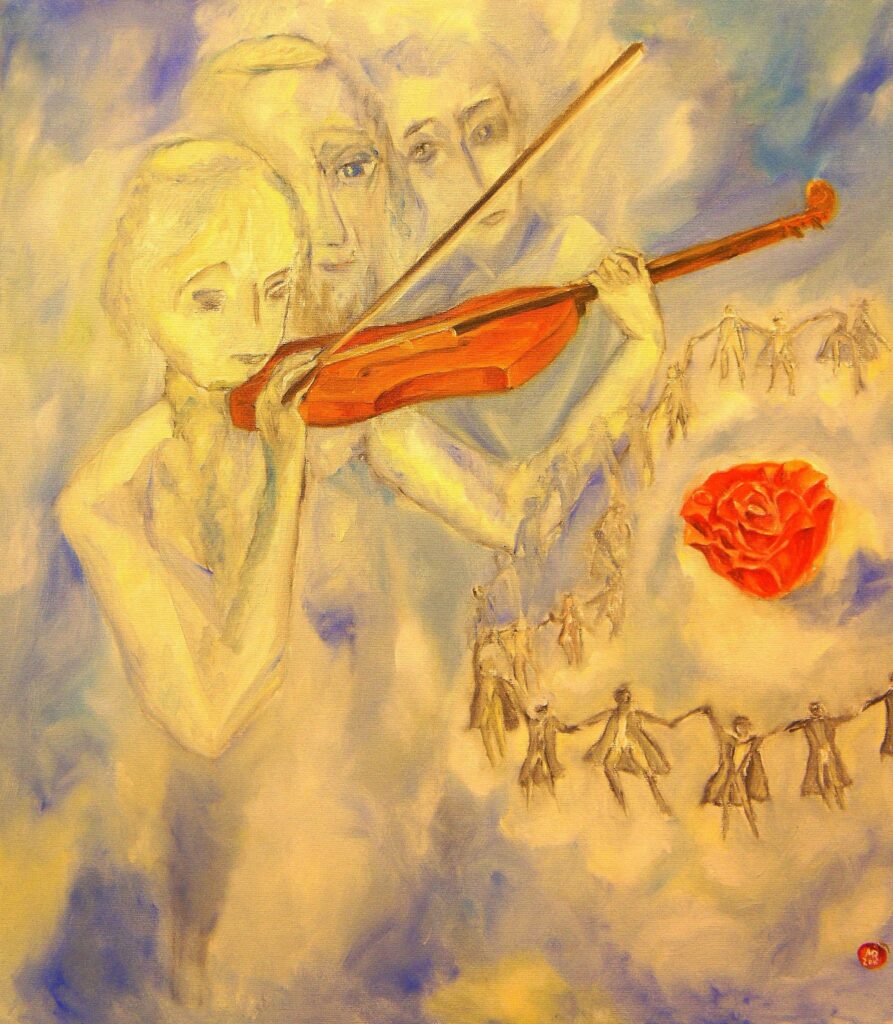
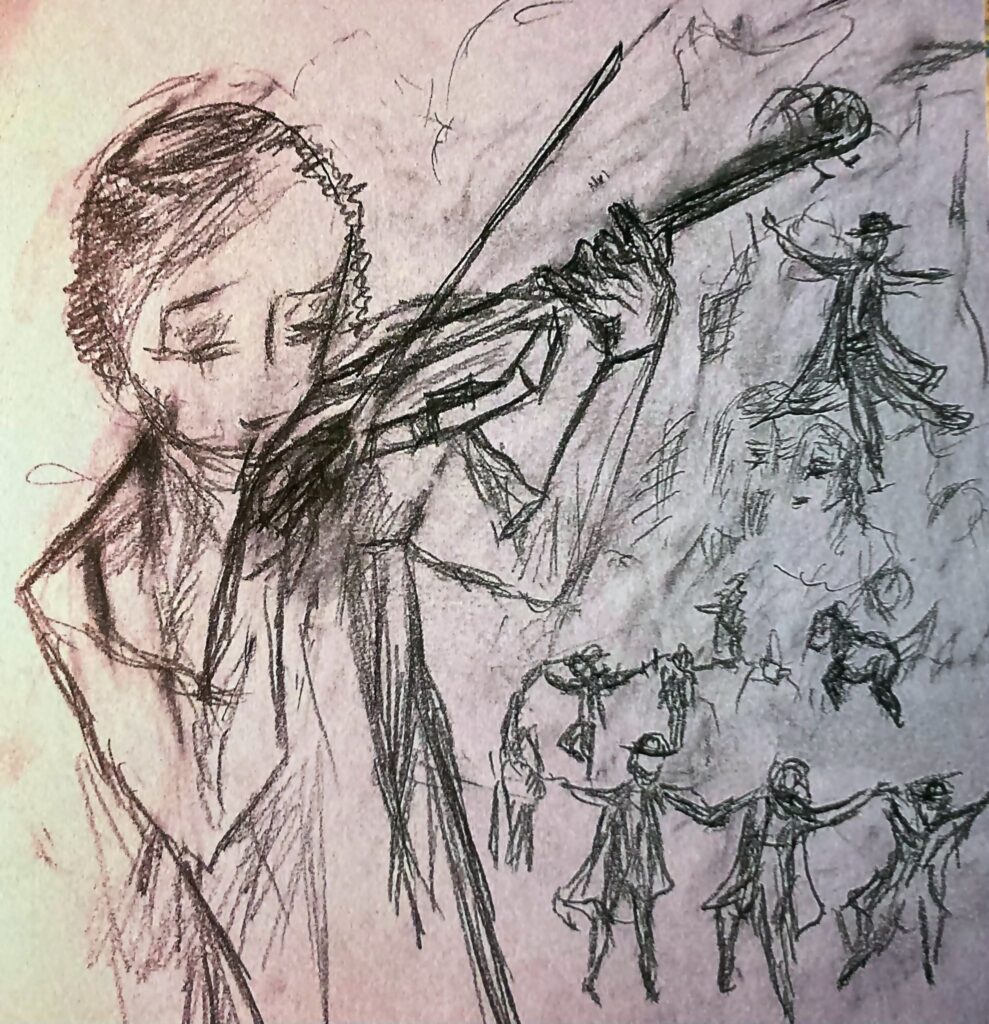
Michael Rogatchi ©. Yiddishe Son. Oil on canvas. 2011, and Study for work, 2011.
When Elie Wiesel saw the painting, he was deeply moved and asked Michael how did he know his story with the violin? We did not at the time. So, a great writer did tell us a heart-rending story about the boy who loved to play his violin and did it exceptionally well. The boy himself, his family in Siget, Romania, and all their friends were positive that when the boy will grow up, he will become a performing violinist. Then the Shoah happened, and on the Shavuot in 1944, the boy and his entire family were seized and sent to Auschwitz, where his young sister was burned alive on the night of arrival in front of all of them. His mother was murdered very soon after that. The father and the boy were left in the Auschwitz barrack, with the boy’s violin as their only and main treasure. The boy’s father tried very hard to manage somehow that his teenage son would survive. He heard that those who were accepted to the Auschwitz inmates’ orchestras, there were two of male musicians, and one of females, do have a better chance to survive. The boy who was shocked to his core by the vicious murder of his sister and mother, and who saw everything that was going around him and his sick father in the death camp, was very far from the tiniest thought of playing, as Elie has told us decades on. His father, who was extremely worried for him, begged him to try. Purely out of his respect and passion towards his suffering father, young Elie agreed and one early morning, he took his beloved violin and tried to rehearse something. It did not last long though. In a minute, the barrack’s guard, who was not German, jumped towards the boy, grabbed his violin, and smashed it in front of his and his father’s eyes. Just like they murdered his sister.
Never again, the great Elie Wiesel, who was a very good and promising violinist, could take a violin in his hand. “I just could not”, he said to us , with that look in his eyes. “ But how on earth did you know, Michael, that a violin was a part of my heart, always?” – “ I did not”, – replied Michael who was deeply affected by the story which Wiesel did not tell often, because it was acutely painful to him till the rest of his life, – “ I just felt that you must be loving a violin, as much as I do. I did not know that you were playing it yourself” – said Michael. “ Well, it seems to me , you knew, somehow”, – smiled Elie Wiesel quietly.
And now on, this Yiddishe Son, Elie Wiesel, does play his violin in Michael’s painting. This is what the power of art can be, bringing incredible discoveries sometimes. The original oil work, dedicated to the great writer and dear friend of ours, was on a long-term loan to the Vilnius Public Jewish Library for 15 years. And here, at this exhibition, you can see Michael’s study for it, which is part of our special Shtetl Songs collection.
In her Litvak Stories I work, Inna tried to bring to life and our memory today the symbols of Jewish tradition and heritage as we know it also from art, including the works of many Litvak artists, and specifically cordial world of his and the Yiddish world’s childhood that has been created by Marc Chagall.
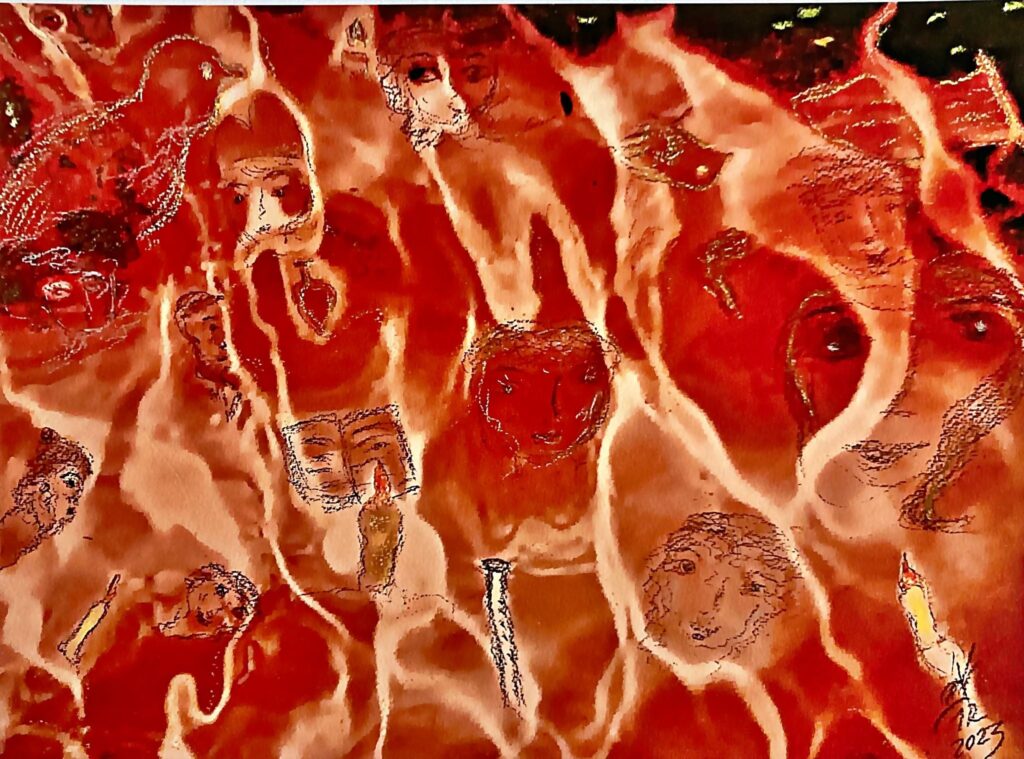
Inna Rogatchi ©. Litvak Stories I. 2023.
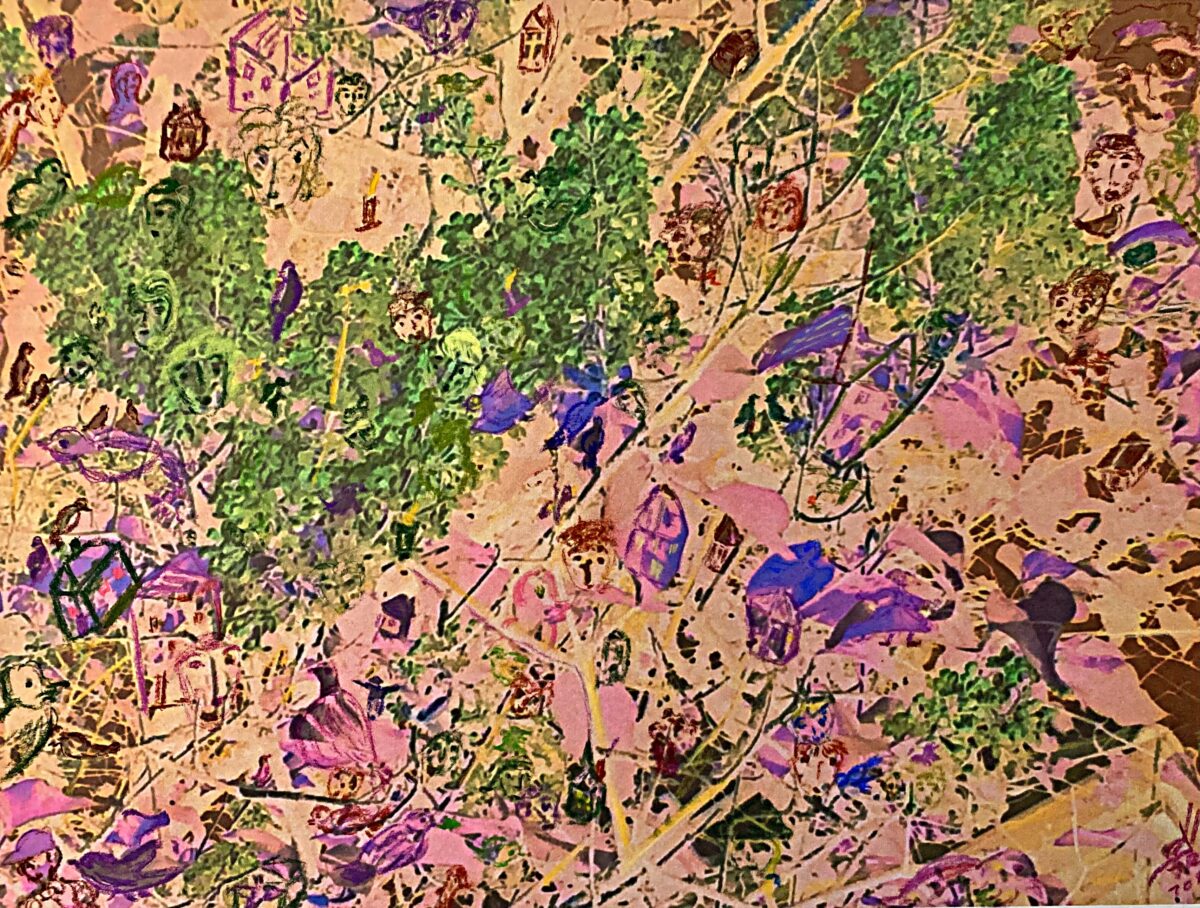
It can be also said that in Inna’s Shtetl Mirage work, she was thinking about the source of the love that Chagall and many other pupils of Yehuda Pen were able to get and transform it into the songs of humanity. We are especially glad that with this exhibition at your museum, we would be able to commemorate Yehuda Pen, the man who has left a very important trace in world culture via his pupils, and whose life turned out to be so difficult and tragic in its end.
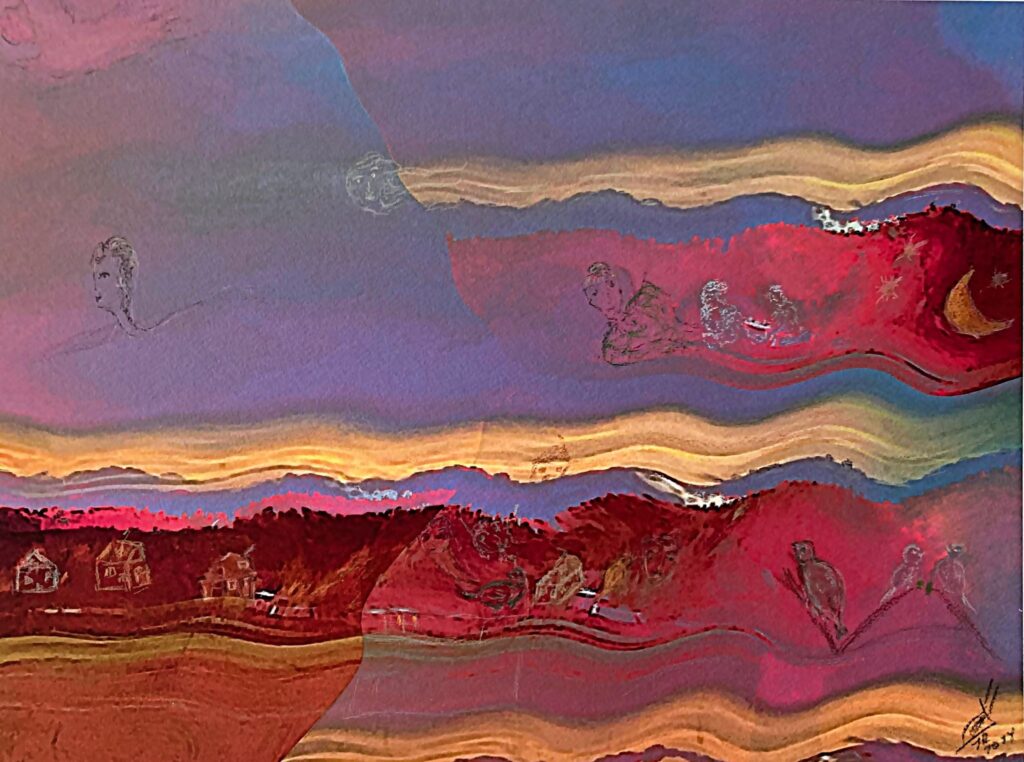
Inna Rogatchi ©. Shtetl Mirage. 2024.
Those two episodes are just single stories related to the works that one can see in our Shtetl Songs exhibition. There are more amazing and engaging stories that could be told about some of the joint collections works, including those that related to one and only Leonard Cohen, whose mother and her family were from Kaunas, and who was a dear friend and important inspiration to both of us for many years. . The works related to this collection belong to many public institutions and notable private collections all over the world, including New York, Paris, London, Jerusalem, Vienna, Zurich, Prague, Helsinki, Tallinn.
We are glad that the works will be exhibited at your museum and that they could be seen by the people visiting it this spring 2026.
Cordial regards from both of us to the Zarasai County museum team and all its visitors.
Inna and Michael Rogatchi
The Rogatchi Foundation
March 31, 2026
Finland